|
|
How Music REALLY Works!
The Essential Handbook for Songwriters, Performers, and
Music Students, 2nd Ed.
|
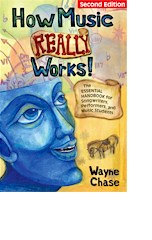 |
Table of Contents
Linked
to 470 FREE Pages!
|
|
PART
I
THE
BIG
PICTURE
INTRODUCTION:
(FREE CHAPTER)
Yes, You Can
Create Compelling, Emotionally Powerful Music and Lyrics
... If You Know What You’re Doing
CHAPTER 1:
(FREE CHAPTER)
What Music REALLY Is, Who Makes It, Where, When, Why
CHAPTER
2:
(FREE CHAPTER)
What the Popular Music Industry REALLY Is, and Where It
Came From
PART
II
ESSENTIAL
BUILDING
BLOCKS
OF
MUSIC
CHAPTER 3:
(FREE CHAPTER)
How Tones and Overtones REALLY Work
CHAPTER 4:
(FREE CHAPTER)
How Scales and Intervals REALLY Work
CHAPTER 5:
(FREE CHAPTER)
How Keys and Modes REALLY Work
PART
III
HOW
TO
CREATE
EMOTIONALLY
POWERFUL
MUSIC
AND
LYRICS
CHAPTER 6:
(FREE CHAPTER)
How Chords and Chord Progressions REALLY Work
CHAPTER 7:
(DETAILS)
How Beat, Pulse, Meter, Tempo, and Rhythm REALLY Work
CHAPTER 8:
(DETAILS)
How Phrase and Form REALLY Work
CHAPTER 9:
(DETAILS)
How Melody and Melody-harmony Integration REALLY Work
CHAPTER 10:
(DETAILS)
How Lyrics REALLY Work
CHAPTER 11:
(DETAILS)
How Repertoire,
Signature, and Performance REALLY Work
PART
IV
MAKING
A
LIVING
IN
MUSIC
CHAPTER 12:
(DETAILS)
How the Music Business and Music Entrepreneurship REALLY Work
INDEX
Detailed
Table of Contents and
Links to Chapters
~ • ~ • ~ •
~
PART
I
THE
BIG
PICTURE
INTRODUCTION:
Yes, You Can Create Compelling, Emotionally Powerful Music and Lyrics ... If
You Know What You’re Doing
-
Music
Notation? Not Here!
-
An
Essential Skill Songwriters and Performers Lack
-
Technique
First, Then Emotional Abandon
-
What You
Need to Know to Understand Everything in
this Book
-
The
Territory Ahead
CHAPTER 1:
What Music REALLY Is, Who Makes It, Where, When, Why
1.1 What Is Music?
1.2 Who Makes Music?
-
Hootin’ and Howlin’: How Animal Sounds Differ from Other
Sounds in Nature
-
Hootin’ and Howlin’: Instinctive vs Learned
-
Human Soundmaking: Discrete Pitches (No More Hootin’
and Howlin’)
-
Human Soundmaking: Entrainment (That’s En-train-ment,
Not Entertainment)
1.3 Where Does Music Come From?
-
Not out of
Thin Air: Music Comes from Evolved Brain “Modules”
-
You Were Born with a Personality
-
Modules Ain’t Computers
-
Evidence
for Brain Modularity
-
Where in
the Brain? Music Modules in Infants
-
Where in
the Brain? Modularity and Universal Musical Grammar
-
Where in
the Brain? Lateralization in Animals and Humans
-
Where in the Brain? Lateralization
and Music
-
Where in
the Brain? Amusia
-
Where in
the Brain? Modularity and Universal Linguistic Grammar
-
Where in
the Brain? FOXP2 and MYH16
-
Where in
the Brain? Aphasia
-
The
Combinatorial Nature of Music and Language
-
How Plastic
Is Your Brain?
-
Mentalese: Thinking Without Language
-
Animal
Intelligence and Culture
-
Nowhere in
the Brain: The “Blank Slate” Myth
-
Cultural
Relativism
-
A Desert
Island Thought Experiment
-
The
Nonsense of Biological Determinism and Social Determinism
-
Human
Universals
-
“The Genes
Hold Culture on a Leash”
-
Inhuman
Music of the Biologically Uninformed: Postmodernism
-
Musical
Universals
-
How Much Is
Music Innate, How Much Is it Culturally Acquired?
-
Where Is
Music? Woven In the Fabric of Life Globally
1.4 When Did Music Get Started?
-
The “When”
Question: Science vs Religion
-
Religious
and Political Assaults on Music
-
Ultimate
Origin of the Adaptation for Music: Common Descent
-
Timeline of
Musical Evolution
-
Did Music
and Language Co-evolve? Similarities Between Music and Language
-
Did Music
and Language Co-evolve? Evidence from Studies of Animals
-
Did Music
and Language Co-evolve? Evidence from Studies of Children
-
Why Your
“Modern” Brain Hasn’t Changed in 50,000 to 100,000 Years
1.5 Why Is There Such a Thing as
Music?
-
Darwinian
Evolution and Adaptations (Including Music)
-
Dawkins’
“Selfish Gene”: Gene’s-eye View of Evolution
-
Hootin’ and Howlin’ Revisited: Sound as a Signalling Device
in Animals
-
Music as an
Adaptation for Mother-infant Communication: We’re All “Preemies” at Birth
-
Music as an
Adaptation for Mother-infant Communication: “Motherese”
-
Music as an
Adaptation for Social Bonding: Survival Through Cooperation
-
Music as an
Adaptation for Social Bonding: Evidence from Studies of Children and
Animals
-
Music as an
Adaptation for Social Bonding: Grooming, Troop Size, and Dunbar’s Number
-
Music as an
Adaptation for Social Bonding: Coalition Signalling
-
Music as an
Adaptation Shaped by Sexual Selection: Sex Differences and the Innate
Taboo
-
Music as an
Adaptation Shaped by Sexual Selection: Sex Differences vs Race Differences
-
Music as an
Adaptation Shaped by Sexual Selection: Evidence from Studies of Animals
-
Music as an
Adaptation Shaped by Sexual Selection: Differences in Male-Female
Cognitive Specializations
-
Music as an
Adaptation Shaped by Sexual Selection: Proportions of Male and Female
Musicians
-
Why Is
There Such a Thing as Music? Probably “All of the Above”
CHAPTER
2:
What the Popular Music Industry REALLY Is, and Where It
Came From
2.1 Origin of Popular Music as an
Industry
-
Where the
Popular Music Industry Came From
-
Paying
Songwriters: A Mercifully Brief History of Legislated Copyright,
Mechanical Right, Performing Right
2.2 African American Dominance
2.3
Your Musical Roots: How the Major Genres Emerged
-
“My Music Is Better than Your Music”
-
Phases of
Genre Popularity: Underground, Breakout, Crest, Mainstream
2.4 Why There’s No Such Thing as
“Progress” In the Arts, Including
Music
-
Progress
Means Technical Usefulness
-
Why Doesn’t
Music Progress?
-
How Songs
Are Useful: Models In Controlled Contexts
-
The Age and
Beauty of Classic Songs
-
Hit Songs vs Great Songs
2.5 Musical Genres as Cultural
Infrastructures
-
Neil Young
Got it Right: The Nature of Cultural Infrastructures
-
Here to
Stay: The Language You Speak
-
Here to
Stay: The Musical Genre You Work In
-
Knowing
Something about "Foreign" Genres Will Help Your Musical Development
2.6 A Brief Look At the Major Genres of
Western Popular Music
-
What
“Genre” Means (Here, At Least)
-
Genres
Emerging Over Time
-
Folk/Roots
Music, ca. 200,000 Years Ago to the Present
-
“Classical”/Art/Formal/Serious Music, ca. 2,500 Years Ago to the Present
-
Minstrelsy
(American), ca. 1830 - 1905
-
Music
Hall/Vaudeville/Operetta/Cabaret, ca. 1850 - 1955
-
Jazz, ca.
1890 - Present
-
Blues, ca.
1890 - Present
-
Ragtime,
ca. 1895 - 1920
-
Musical/Film (Broadway/West End), ca. 1920 - Present
-
Country/Bluegrass (Popularized), 1925 - Present
-
Gospel
(“Gospel Blues”), ca. 1930 - Present
-
Swing, 1935
- 1946
-
R & B/Soul,
ca. 1945 - Present
-
Rock/Pop,
1954 - Present
-
Reggae,
1968 - Present
-
Dance/Electronica, 1975 - Present
-
Hip-hop,
1979 - Present
-
World
Music, 1982 - Present
PART
II
ESSENTIAL
BUILDING
BLOCKS
OF
MUSIC
CHAPTER 3:
How Tones and Overtones REALLY Work
3.1 Tones and Their Properties
-
“Anything You Can Do”
-
Pitch: “I Can Sing
Anything Higher Than You”
-
Loudness: “I Can Say
Anything Softer Than You”
-
Duration: “I Can Hold
Any Note Longer Than You”
-
Tone Color: “I Can Sing
Anything Sweeter Than You”
3.2 Overtones: The Harmonic Series
-
The Tone Path To Your
Brain
-
A House Is Not a Home,
and a Tone Is Not a Tone
-
So, What Exactly Are
Harmonics/Overtones?
-
Not Just One Overtone—A
Bunch of ‘Em
-
The Harmonic Series
(Overtone Series)
-
Your Brain’s Automatic
Tone-processing Skill
-
Bring Out Those
Overtones!
-
Overtones Identify
Musical Instruments and Voices
3.3 How Musical Instruments Work
(Including the Voice)
-
What’s A Musical
Instrument, Anyway?
-
Setting Resonators in
Motion, Directly and Indirectly
-
Categories of Musical
Instruments
-
Idiophones: Percussion
Instruments without a Membrane
-
Membranophones: Percussion Instruments with a
Membrane
-
Aerophones: Wind Instruments, Including the Voice
-
Chordophones: Stringed
Instruments
-
Electrophones:
Instruments That Produce Sound Electronically
3.4 Tone Properties and Their
Emotional Effects
-
Emotional Valence and
Intensity
-
Emotional Effects of
Pitch
-
Emotional Effects of
Loudness
-
Emotional Effects of
Tone Color
CHAPTER 4:
How Scales and Intervals REALLY Work
4.1 Scales: Brain-averse, Brain-friendly
-
What’s a Scale?
-
Chalk Marks on a Cello
Fingerboard
-
Brain-averse: Why Random
Scales Suck
-
In Search of an
Organizing Principle that Will Yield a Brain-friendly Scale
-
Using Simple Frequency
Ratios to Build a Brain-friendly Scale
-
That Familiar “Do-Re-Mi”
Scale
-
More Brain-averse:
Equal-interval Scales
-
Brain-friendly: A
Naturally-selected Specialization for Simple Frequency Ratios
-
Filling In the Last
Gaps: The Chromatic Scale
-
E Unum Pluribus ... Many Scales Out of One
4.2 Intervals
-
The Basic Intervals
-
Interval Names Explained
-
Perfect Fifths and Scale
Construction: Monty Pythagor’s
Method
-
The Pythagorean Comma
-
Why Pythagorean Scales
Emerged Independently on Several Continents
-
Consonance and
Dissonance
-
Dissonance: Freaky
Frequency Ratios
-
Intervals Within Scales
-
Complementary Intervals
-
Why Intervals Are the
Real Musical Units of Melodies and Chords
4.3 Interval Dynamics
-
Musical Drama
-
Scale Degrees
-
Curvature of the Major
Scale
-
Interval Dynamics:
Curved Arrows Through Your Brain
-
Interval Dynamics:
Musical Road Trips
-
Interval Dynamics:
Curved Arrows and Context
-
Interval Dynamics:
Manipulating Tonal Tension
-
The Tyrannical Octave
4.4 Emotional Effects of Intervals
CHAPTER 5:
How Keys and Modes REALLY Work
5.1 Scales from Around the World
-
What Scales Have In
Common: Tones In Simple Frequency Ratios
-
Major Pentatonic Scale
-
Minor Pentatonic Scale
-
Why “Similar” Scales
Sound So Different: The Staircase Analogy
-
Blues Scale
-
An Arabic Scale
-
Indian or Whole Tone
Scale: An Equal-interval Scale That Works
-
A Chinese Pentatonic
Scale
-
Hungarian Gypsy (Roma)
Scale
5.2 The Modes: Scales of the Diatonic
Order
-
The Diatonic Order: A
Distinctive Pattern of Tones and Semitones
-
Flavours of the Diatonic Order
-
Church a la Mode
-
Some Popular Songs with
Church Mode Melodies
-
More Scales Than a
Catfish (2,047 to be Exact)
-
Why the Church Modes
Didn’t Make the Big Time
5.3 Keys, Major and Minor
-
The Two Surviving Modes
-
Keys and Scales
-
Music’s “Theory of
Relativity” (Not to be Confused with Cultural Relativism)
-
All 12 Major Scales In
One Convenient Table
-
All 12 Descending
Melodic Minor Scales In One Convenient Table
-
All 12 Ascending Melodic
Minor Scales In One Convenient Table
-
All 12 Harmonic Minor
Scales In One Convenient Table
-
How Digger’s 10-Note
“Grand Minor Scale” Simplifies Matters
-
Relative Numbers of
Popular Songs In Major Keys, Minor Keys, and Modes
-
10 Emotional Effects of
Modes
5.4 Tuning, Temperament, and
Transposing
-
“How Come I Can’t Tune
this #@*&!% Thing?”
-
Don’t Lose Your Equal
Temperament
-
“It’s Too Low (or High)
for My Voice”: Transposition
-
How Transposing
Instruments Work
5.5 Modulation and Tonality
-
The Keys, They Are A-changin’ (Good Thing, Too)
-
A Brief, Star Spangled
Modulation
-
Signalling a Shift In Tonal Centre
-
“The Centre Cannot Hold”
(Or Can It?)
-
Keys in Cozy
Relationships
-
Octaves and Fifths:
Simple Frequency Ratios, Close Relatives
-
Why Heinichen’s Circle of Fifths, While Somewhat Useful, Is
Often Misunderstood and Misused
-
Tonality and Tonal Music
-
Distinguishing Tonal
Music from Modal Music and Atonal Music
-
Emotional Effects of
Tonality
PART
III
HOW
TO
CREATE
EMOTIONALLY
POWERFUL
MUSIC
AND
LYRICS
CHAPTER 6:
How Chords and Chord Progressions REALLY Work
6.1 Where Chords Come From
-
What’s a Chord?
-
The Jimi Hendrix Experience without Jimi: Why Melody-free
Harmony Does Not Stand on its Own
-
Harmony’s Own Organizing
Principle
-
Properties of a Major
Triad (This Looks Familiar)
-
Exploring the Innards of
the Major Triad
-
Stacking Intervals, Then
Turning Them Upside down and Disturbing Them
6.2 Triads and Sevenths: The
Foundation of All Western Tonal
Harmony
-
Restless Intervals Make
Restless Chords
-
The Paradox of
Unsettled-sounding Consonant Inversions
-
That Moody Minor Sound
Again
-
Diminished and
Augmented: Disturbed Chords (But in a Nice Way)
-
The Most Boring Tune in
the World
-
Harmony’s Gotta Move (Coherently, of Course)
-
That Other Chord Type:
The Seventh
-
And What about All Those
Jazz Chords Such as 9ths, 11ths, 13ths?
-
Slash Chords
-
Power Chords (Not to be
Confused with Power Cords)
-
Drone On
6.3 Introduction to Chord Progressions
-
What Are Chord
Progressions Good For?
-
Dynamic Qualities of
Chords
-
Understanding Harmony:
Terms of Endearment
6.4 The Nashville Number System
-
“Harmonic Degree”: Just
a Fancy Name for “Chord”
-
The Seven Harmonic
Degrees
-
An Example: The Seven
Harmonic Degrees in the Key of C Major/A Minor
-
The Nashville Number
System of Chord Notation: Why It’s Important and How It Works
6.5 The Four Types of Chord
Progressions
-
"Harmonic Interval":
Just a Fancy Name for "Chord Change" or “Chord Progression”
-
How Chords Actually
Change
-
The Tricky Business of
Naming Harmonic Intervals (Chord Progressions)
-
Fifth Progressions, Up
and Down
-
Third Progressions, Up
and Down
-
Second Progressions, Up
and Down
-
Chromatic Progressions,
Exiting and Returning
-
Summary and Examples of
the Four Types of Chord Progressions
6.6 Scales of Chords? Yes!
-
The Key to Boldly Going
Way Beyond the “Three-chord Wonder”
-
Unrest and Direction:
The Magic of V – I
-
Harmonic “Scale Neighbours”
-
The Harmonic Scale: Will
the Circle Be Unbroken?
-
Families Within the
Circle
-
Which Direction Home?
-
The Melodic Scale: Two
Directions Home
-
How Does it Feel to Move
Clockwise Round the Harmonic Scale?
-
How Does it Feel to Move
Counterclockwise? (Hint: The Cat Wants Back In)
-
The Harmonic Scale: One
Direction Home
-
Fixing Another “Minor”
Problem
-
Harmonic Motion and
“Musical Punctuation” (Cadence)
6.7 Inside the Circular Harmonic Scale
-
The Problem of Harmonic
Ambiguity
-
Dissonance to the
Rescue!
-
The Dominator: Why the
V7 Chord Controls Harmony
-
Last Tweaks of the
Harmonic Scale
-
The Harmonic Scale:
Final (“Default”) Version
-
Two Different Animals:
Comparing the Circle of Fifths with the Harmonic Scale
-
Circle of Fifths: The Mistake of Treating Keys as “Chords”
-
Comparing Melodic Scales
with Harmonic Scales
6.8 Chase Charts: Chord Progression
“Maps”
-
You Can Use “Maps” of
Harmonic Scales to Create Beautiful, Powerful Chord Progressions
-
What’s a Chase Chart?
-
What Does a Chase Chart
Look Like?
-
How to Sketch a Chase
Chart
-
Sources of Harmonic
Scale Chords with Nashville Numbers for Every Key
6.9 Chase Charts of the Four Types of
Chord Progressions
-
6.9.1 How to Do a Chase Chart of Your Own Song (or Any Other
Song)
-
Chase Charts of Fifth
Progressions, Up and Down
-
Chase Charts of Fifths
Up, To and From the Tonic Chord
-
Chase Charts of Fifths
Up, Away from the Tonic Chord
-
Chase Chart of Secondary
Dominants
-
Chase Charts of Third
Progressions, Up and Down
-
Chase Charts of Second
Progressions, Up and Down
-
Chase Charts of
Chromatic Progressions, Exiting and Returning
-
Chase Charts of the
General Patterns of Chord Progressions
6.10 Examples: Chase Charts of Great
Songs without Modulation or
Chromatic Chords
-
Chase Charts of the
General Patterns of Chord Progressions
-
Group 1: List of Great
Songs without Modulation or Chromatic Chords
-
“Heartbreak Hotel”: I –
IV – V Eight-bar Blues
-
“Tracks of My Tears”:
Suspense of Half-closes
-
“Jambalaya (On the
Bayou)”: The Strongest Chord Progression in All of Music
-
Twelve Bar Blues:
Deceptive Cadence and “Turnaround”
-
“When a Man Loves a
Woman”: Another Kind of Deceptive Cadence
-
“Walking After
Midnight”: Progression Reversal
-
“Five Foot Two, Eyes of
Blue”: Consecutive Secondary Dominants
-
“Hey Joe”: A Fifths-up
Progression That Works
-
“Return to Sender” (And
Loads of Other Songs That Use the Same Progression): A Mellifluous
Thirds-based Progression
-
“Midnight Train to
Georgia”: Totally Avoiding Fifths Up
-
“Danny Boy”: A Little
Mode Mixing without Modulating
-
“Moondance” A Classic of
the Minor Mode
-
“All Along the
Watchtower”: A Masterpiece with Second Progressions Only
-
“I’ve Got You under My
Skin” A 20-chord Masterpiece
-
“Yesterday”: One of the
Most Covered Songs of All Time
-
“The Star Spangled
Banner”: A British Teen’s Greatest Hit
6.11 Examples: Chase Charts of Great
Songs without Modulation, with
Chromatic Chords
-
Group 2: List of Great
Songs without Modulation, with Chromatic Chords
-
“Hey Jude”: Naaa-na-na Na-na-na-na For Several Minutes
-
“Carefree Highway”: Slippin’ Away on a Chromatic Chord
-
“Wild Horses”: Unusual
Use of Minors
-
“September Song”: How to
Use More than One Chromatic Chord
-
“Crazy”: When the
Tempo’s this Slow, You Notice Every Chord
-
“Trouble in Mind”: More
Secondary Dominants
-
“Sundown”: Slippin’ Away On the “Carefree Highway” in
Reverse
-
“I Heard it Through the
Grapevine”: Four-chord Ingenuity
-
“Bridge Over Troubled
Water”: Harmonic Heaven and Hell
6.12 Modulation Ways and Means
-
Modulation: The Soul of
the Western Tonal System
-
Near vs Remote Modulation
-
Relative Key Modulation
-
Parallel Key Modulation
-
Shift Modulation (Don’t
Do This!)
-
Sequential Modulation
-
Pivot Chord Modulation
6.13 Examples: Chase Charts of Great
Songs with Modulation, without
Chromatic Chords
-
Group 3: List of Great
Songs with Modulation, without Chromatic Chords
-
“I Got Plenty O’ Nuttin’”: Two Kinds of Modulation
-
“Three Bells (The Jimmy
Brown Song)": Pivoting to a Closely Related Key
-
“Kodachrome”: Using the Same Chord (Root) to Pivot Both
Ways
-
“Dear Landlord”: A Tour
through Four Keys in 60 Seconds
-
“One Fine Day”:
Pivot-Shift-Pivot
-
“Free Man in Paris":
Taking Advantage of Triad Stability
-
“Kaw-liga”: Parallel Key Modulation
-
“Lovesick Blues”:
Relative Key Modulation
-
“Gimme Shelter":
Simultaneous Parallel Keys, Forceful Second Progressions—and Only Three
Chords
6.14 Examples: Chase Charts of Great
Songs with Modulation and
Chromatic Chords
-
Group 4: List of Great
Songs with Modulation and Chromatic Chords
-
“Sittin’ on the Dock of
the Bay”: Modulation and the Power of Simple Triads
-
“It Was a Very Good
Year”: Sequential and Parallel Key Modulations
-
“The Girl from Ipanema": Transient Sequential Modulation
-
“Georgia on My Mind”:
More Relative Key Modulation
6.15 When Chord Progressions Go
Bad ...
6.16 What About Chord Progressions
Based On the Church Modes?
-
Modal Harmonic Scales
-
Dorian Mode Harmonic
Scales
-
Phrygian Mode Harmonic
Scales
-
Lydian Mode Harmonic
Scale
-
Mixolydian Mode Harmonic Scale
-
Locrian Mode Harmonic Scale
6.17 Chords and Chord Progressions:
Maximizing Emotional Impact
6.18 Ten Chord Progression Guidelines
-
Guideline 1: Start with
the Circular Harmonic Scale as Your Basic Chord Progression Framework
-
Guideline 2: Learn How
to Use Chase Charts to See How a Song’s Chord Progression Actually Works
-
Guideline 3: Use the Chord Progression Chart (Appendix
3) to Save Time and Avoid Frustration
-
Guideline 4: Take
Advantage of Tonic Chord Stability
-
Guideline 5: Take
Advantage of Dominant Chord Instability
-
Guideline 6: Make
Structured Use of Chords of the Same Type
-
Guideline 7: Take
Advantage of Major Triad Consonance to Progress to Chords Built on the
Same Root
-
Guideline 8: Try Not to
Commit the Sin of Monotony—Use Modulation, Variant Chords, Chromatic
Chords
-
Guideline 9: Keep in
Mind the Emotions People Associate with Chords
-
Guideline 10: Use a
Roedy Black Chord Chart to Save Time, and to Avoid Interrupting Your
Creative Flow
CHAPTER 7:
How Beat, Pulse, Meter, Tempo, and Rhythm REALLY Work
CHAPTER 8:
How Phrase and Form REALLY Work
CHAPTER 9:
How Melody and Melody-harmony Integration REALLY Work
CHAPTER 10:
How Lyrics REALLY Work
CHAPTER 11:
How Repertoire, Signature, and Performance REALLY Work
PART
IV
MAKING
A
LIVING
IN
MUSIC
CHAPTER 12:
How the Music Business and Music Entrepreneurship REALLY Work
INDEX
|
