|
PAGE INDEX
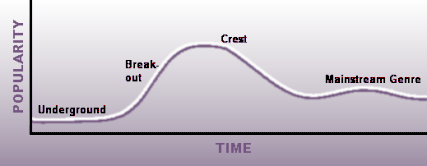
~ • ~ • ~ • ~ Emerging musical genres go through a characteristic series of
phases. The Gold Standard Song List, if taken as a more or less
representative data sample of genre popularity, reveals a genre
popularity profile. This profile applies to most musical genres over
time (Figure 1 below). FIGURE 1 Genre Popularity Over Time
1. ORIGINS,
OR “UNDERGROUND” • Typically, a musical genre begins as an underground movement. This formative phase often lasts many years, even decades. • New genres and sub-genres emerge in several ways. Among them: - Musicians from outside a geographical region move in and bring new instruments and new styles of playing, singing, and songwriting to an established local musical tradition. - A genius comes along and decides to shake things up (Charlie Parker, Bob Dylan).
- New technology makes it possible to create new sounds.
• At some point the genre breaks out as a widely recognized musical phenomenon in popular culture. • The new style attracts the attention of masses of people, including musicians just getting started, musicians working in other genres, music consumers, and music business people.
• Suddenly, performers everywhere are playing in the new
style. Lots of the new music get recorded and sold. Over a
comparatively short period of time, the new genre or
sub-genre becomes all the rage. • Inevitably, within a decade or two, the popularity of the genre crests and starts to subside. • Along the way, it spins off numerous sub-genres.
• The original one does not go away.
• Instead, with few exceptions, it remains a permanent mainstream genre, co-existing, influencing, and being influenced by, many others. For example, when bluegrass was “invented” in the 1930s and 40s, it did not replace traditional country music. Neither did “new country,” a couple of generations later. When hip-hop and electronic dance music came along, they did not replace mainstream pop or rock. • So many people accept and adopt the elements of the genre that it becomes a cultural infrastructure (more on this a bit later). It settles into the mainstream of popular culture—not as popular as it once was, but permanently accepted and established.
• Every so often a long-established mainstream genre
experiences a period of renewed popularity ("revival") that
may extend for some years.
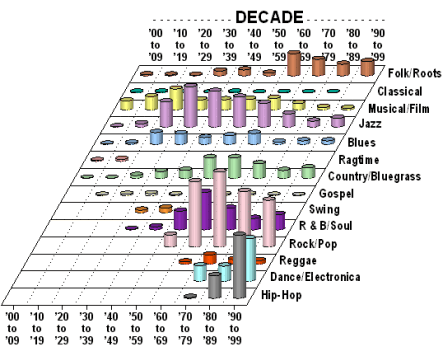
The
Gold Standard Song List
(GSSL), a sample of 5,000 songs
over 100 years, provides a visual representation of genre popularity
profiles over time (Figure 2): FIGURE 2 Gold Standard Songs by Genre and Decade
Today, many young people, while identifying mainly with their music (the music of their youth), like to sample music across genres and eras. On a single iPod you might find the Clash, Beethoven, Aretha Franklin, Eminem, Iggy Pop, Bjork, Frank Sinatra, Johnny Cash . . .
NEIL YOUNG GOT IT RIGHT: THE NATURE OF CULTURAL INFRASTRUCTURES
It's not just rock 'n' roll that's here to stay. It's also hip-hop and jazz and country. A musical genre is a cultural infrastructure—something
so many people know about and support that it becomes a more or less permanent
artistic (or technological) fixture in the mainstream on society.
You cannot easily dislodge an infrastructure, even if you and a lot of others would prefer something else in its place. Technological infrastructures especially have monopoly characteristics. The internal combustion engine and the Microsoft Windows operating system are technological infrastructures. A lot of people don't particularly like either of them. But, as is a characteristic of infrastructures, that they stick around because so many people use them, and alternatives have unappealing drawbacks (inconvenience, lack of support, expense, etc.).
HERE TO STAY: THE LANGUAGE YOU SPEAK The language you speak is a cultural infrastructure. Everybody who speaks the language you speak shares the same vocabulary (more or less) and uses the same grammatical rules. Artists working with language manipulate words and grammar to create works of art such as novels, plays, and song lyrics. Successful language artists innovate with words and grammar, but preserve enough of the language's commonly-used vocabulary and observe enough of its grammatical rules to ensure reasonable audience accessibility. As discussed in Chapter 1 of How Music REALLY Works!, artists who break all the rules do not communicate with anyone on any humanly accessible level. If an artist working with language employs too much fractured grammar and too many twists of vocabulary, the novel or play or song lyric becomes incomprehensible. Without adequate adherence to convention, audiences find the work inaccessible and simply turn away from it, confused and irritated.
HERE TO STAY: THE MUSICAL GENRE YOU WORK IN When several
languages blend to form a new language, the new language tends to have a unique
identity with a unique vocabulary. Those who don’t know the language cannot
understand it until they learn the language, because words have referential
meaning.
Not so with music.
When
several musical genres blend to form a new one (such as rock, originally a blend
of R & B and country), the new genre can easily be understood. You can recognize
a tune whether it’s played as a rock, jazz, or country arrangement because
musical notes do not have referential meaning. Like languages, musical genres are cultural infrastructures. Most musical genres, once established as infrastructures, do not fade away (although, like some languages, some musical genres have become extinct for various reasons. A couple of examples are noted below). A musical genre functions something like a language. Each musical genre has a particular set of stylistic elements, which millions of songwriters and performers working in the genre observe. These elements define a genre, just as vocabulary and grammatical rules define a language. An established genre does not go "out of date," any more than an established language goes out of date. Musicians use various technologies to create music, and those technologies go out date. New instruments and electronic gear render old gear obsolete. But musical genres, being art forms and not technologies, do not progress. • Punk rock, for example, emerged in the 1970s. Today new punk bands are forming all the time. Their members write new punk songs and record them on equipment that’s different than the gear that existed in the 1970s. Moreover, when hip-hop and electronic dance music came along, they did not replace punk. • Same with bluegrass. New bluegrass bands are constantly forming, performing and recording both classic and new tunes in the bluegrass tradition. When bluegrass was “invented” in the 1930s and 40s, it did not replace traditional country music. Neither did “new country,” a couple of generations later. All of this applies to every major genre and sub-genre: heavy metal, hip-hop, jazz, blues, reggae, folk, electronica. Songwriters
and performers create new genres and sub-genres of music all the time. Some
stick around and become cultural infrastructures, some don’t.
KNOWING SOMETHING ABOUT “FOREIGN” GENRES WILL HELP YOUR MUSICAL DEVELOPMENT Listening to the great songs of other genres will spark your musical
imagination. You will be able to better envision how you could
incorporate elements from other genres into your own musical art,
the way language artists incorporate elements of style, grammar and
vocabulary from other languages into their works.
The more you listen to, remember, and absorb at least a sampling of the best songs of genres other than your own, the more likely you will be able to create a unique body of original songs and a performing style that sounds like nothing anyone's heard before. A sound that grabs the ears of audiences and holds them. A sound that makes them wonder, “Now where did that come from?”
GENRES OF THE GOLD STANDARD SONG LIST What conditions define the emergence of a new genre in popular music? • The new music contains a set of several significant stylistic elements not widely heard in that particular combination in other musical genres. • A lot of performers and songwriters adopt the new set of stylistic elements in their playing, singing (including rapping) and songwriting (including beatmaking).
• A large number of performers and songwriters maintain the
use of the set of stylistic elements over time. Recall from Chapter 1 of How Music REALLY Works! that music is combinatorial. A finite set of stylistic songwriting and performing characteristics define a particular genre. For example: • Musical instruments of choice • Dominance of vocal vs instrumental songs • Characteristic vocal style • Dominant subject matter of lyrics • Variable emphasis on elements such as rhythm, harmony, melody, vocal style, instrumental solos • Dominant type of rhythmic pulse • Characteristic tempo range • Degree of emphasis on improvisation • Degree of emphasis on syncopation • Variable use of modes and scale types And scores of others. Since music is combinatorial, all it takes is a handful of musical
elements and a set of rules governing each that a significant number
of musicians agree to play by. The result: music strikingly different
from any other. Imagine, for example, what country music would have sounded
like if, in place of the steel guitar as a key element of the country
sound, bagpipes had had that role from the beginning. That one
instrumental difference would have made country music sound a whole lot
different from what we’re accustomed to hearing today. A major genre of popular music typically spins off numerous sub-genres. For example: • In jazz, a couple of spin-offs were bop and fusion (among many others) • In country, honky tonk and bluegrass (again, among many others) • In rock, metal and punk • In R & B/Soul, Motown and funk
• In hip-hop, gangsta and crunk There are hundreds and hundreds of sub-genres and sub-sub-genres. At last count, there were 647,512 genres and sub-genres in
popular music.
No, wait! Some guy with his laptop in his bedroom in Milton
Keynes, England, has just created another one. That makes
647,513.
No, wait!
A
trio of 14-year-old girls in Amarillo, Texas, has just created a sub-genre of a
sub-sub-genre. Now we’re up to 647,514.
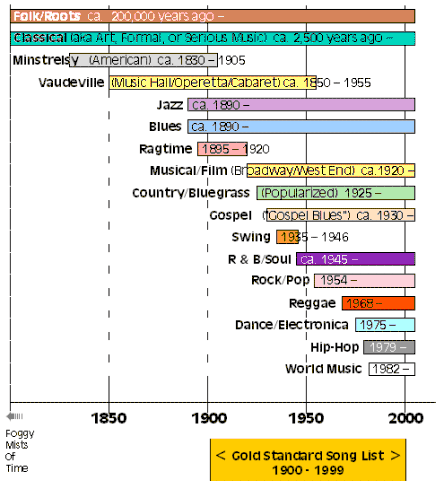
No, wait! ... Figure 3 below shows the major genres of Western popular music
(at least in the main English-speaking countries) from approximate
breakout dates to the present. The GSSL only applies to the right
half of Figure 3. FIGURE 3 Genre Breakouts In Historical Perspective
Occasionally, a major genre, after flourishing for a time, becomes
extinct, such as ragtime and American minstrelsy. Usually the
reason is that another genre comes along with similar, but not
identical characteristics, and absorbs the first one. For example,
vaudeville took over from minstrelsy. Later, the Broadway-style
musical succeeded vaudeville. That does not mean the Broadway
musical represented artistic progress over vaudeville. Many
Broadway style revues use elements pioneered in vaudeville, but
presented with technologically updated stagecraft.
Next, brief sketches of each of the genres in Figure 3 above.
FOLK
/ ROOTS
MUSIC,
CA. 200,000 YEARS
AGO
TO THE PRESENT Origins • Folk music has several alternative names, such as community music, peoples music, and music in the oral tradition. • Folk music likely goes back 100,000 to 200,000 years— before Homo sapiens walked out of Africa and colonized the rest of the planet. • To get an idea of how old folk music is, have a look at the horizontal bar at the top of Figure 3. It represents only 200 years. Now imagine this: to accurately represent 100,000 to 200,000 years, that horizontal “Folk/Roots” bar would have to stretch to the left roughly 190 to 380 feet (58 to 116 metres)! That’s how old folk music is, compared with all other musical genres.
• With the advent of the printing press in the 15th
Century, vendors hawked “broadside ballads” in the streets—folk ballads printed
on one side of a sheet. Early journalism. Breakout
• In the English-speaking countries, the folk music of the UK
and Ireland had a major revival that began in the late 1950s
and rocketed in popularity in the early 1960s. Countless
musicians in the UK, America, Canada, and other
English-speaking nations wrote countless original songs in
the English-Celtic folk tradition.
Crest
• The folk music revival crested in the latter part of the 1960s
and gave rise to sub-genres such as folk-rock (Dylan, the
Byrds, etc.) and the folk-soul music of artists such as Van
Morrison (for example, the beloved album Astral Weeks).
Mainstream Genre • Today, the term “roots” often appears in conjunction with folk music. The folk music revival subsided in popularity, and folk/roots settled into the mainstream of popular culture by the 1980s.
You could define classical music ultra-narrowly as the period of European art music of ca. 1750 to 1825 (Haydn, Mozart, Beethoven) that followed the Baroque era and preceded the Romantic. Or you could define classical music broadly as formally-notated art music, starting with some of the music of the Greeks, 2,500 years ago. In which case, the bar second from the top in Figure 3 would need to stretch to the left about 4.8 feet (1.5 metres). Not a long time compared with folk music, but much longer than the genres of popular music with which we’re familiar today. Historically,
racism prevented music from crossing cultural lines. For centuries, Europeans
and white Americans considered African music “primitive” and inferior to music
of European origin, especially the music of the baroque, classical, and romantic
composers of the common practice period (1600 - 1900). People with classical
music backgrounds have historically tended to value melody and harmony over
rhythm and rhythmic lyrics. The European aristocracy of the common practice
period who patronized composers actually believed they were fostering the
“progress” of music. At classical music concerts, audiences were (and still are) expected to sit quietly and listen to The Music. No nodding to the beat (or nodding off), no tapping, clapping, or (horrors) singing or dancing. Pretty much the exact opposite of, say, a hip-hop or rock concert.
MINSTRELSY (AMERICAN), CA. 1830 - 1905 Origins • American minstrelsy emerged in the 1830s. White musicians, mainly solo or duo acts, would black-face themselves and perform songs and dances from African American culture.
• Horrible
racist stereotyping (“See the happy dancing plantation slaves!”) didn’t bother
audiences of the day. Even Thomas Jefferson (1743 - 1826), author of the famous
phrase, “All men are created equal,” kept a couple of hundred slaves and did not
see fit to free them. Breakout • By the 1840s, troupes of 5 or 10 players were common, mainly white males, but not exclusively. • Abolishionist minstrel troupes had some success.
• America successfully exported the minstrel show to Europe.
Of course minstrels had been a fixture in Europe for
centuries, but the American style minstrel show was
something else. Crest • After the Civil War, troupes grew larger, and there were more African American troupes. • Here is one description of American minstrelsy:
Mainstream Genre • James A. Bland, America’s first great African American songwriter (“Carry Me Back To Old Virginny,” official state song of Virginia), wrote hundreds of songs but did not make any money on royalties. However, he did earn a good living as a member of various minstrel troupes. • Stephen Foster, an abolishionist northerner, wrote many songs for minstrel shows, with lyrics in dialect that did not mock or denigrate plantation slaves.
• In the decades following the Civil War, the racist nature of
much of minstrelsy led to its demise, concomitant with the
rise of vaudeville, which had taken over from minstrelsy as
variety stage entertainment by the first decade of the 20th
Century.
Origins • The Industrial Revolution began in the latter half of the 18th Century and dramatically transformed European and North American society. Decade after decade, people migrated from the countryside to work in urban factories and foundries.
• Workers demanded more and better entertainment than
simply congregating in ale houses and singing traditional
songs. By the mid-1800s, music halls were meeting that
demand with a variety of entertainment for the working
masses. Breakout
• Some musicians became professional songwriters, furnishing
music hall entertainers with new songs. This marked the
beginning of the modern popular music industry. Crest • In America, a decade or two after the Civil War, music hall entertainment became established in North America in the form of vaudeville. It eventually superceded American minstrelsy. • Other varieties of music hall entertainment included operetta (in both Europe and North America) and cabaret (mainly Germany and France).
• Great composers and entertainers of the music
hall/vaudeville age include: Gilbert and Sullivan, Noel Gay,
Harry Lauder, Vera Lynn, Victor Herbert, George Formby,
Noel Coward, George M. Cohan, Albert and Harry von Tilzer,
James Reese Europe, Eddie Cantor, Fanny Brice, Al Jolson,
Sophie Tucker, Bert Williams, and Rudy Vallee. Mainstream Genre • At the turn of the 20th Century, vaudeville was the most popular form of entertainment in North America, as was music hall culture in England. • All major cities and towns in Europe and North America had music halls to accommodate “light” entertainment variety shows. • In America, other ways of presenting variety entertainment, especially radio and film, began to displace vaudeville in the 1920s. However, the music hall genre lived on in Europe for several more decades. • The Broadway style musical replaced the vaudeville show as stage entertainment. Eventually all of the elements of vaudeville and music hall had migrated to other media or were no longer referred to by their original names (e.g., musical revues, movie musicals, and television variety and talk shows).
• The Beatles recorded a landmark album in the British music
hall tradition: Sgt. Pepper’s Lonely Hearts Club Band (1967).
Origins • Jazz started in the port of New Orleans in the early 1890s, when the city was still a French colony. The African American musical culture of syncopation, polyrhythm, melodic embellishment, and improvisation mashed up with European (especially French military) musical traditions and instrumentation: marches and rhythmically “square” dance forms; brass instruments and the upright piano.
• New
Orleans Creole musicians (American born, of African American and
European—especially French—ancestry), such as Buddy Bolden, King Oliver, Kid Ory,
and Jelly Roll Morton, lived with, and played music with, self-taught African
American musicians. Altogether they created a new genre, jazz. Breakout • The Original Dixieland Jazz Band made its first recording in 1917. By the 1920s, the Mississippi riverboats had carried jazz north to Kansas City, Chicago, and New York. Not long after, jazz had spread all over America and on to Europe. (Recall that in the 1930s, the Nazis banned jazz.)
• White musicians played alongside black musicians, helping
to focus more attention on the appalling state of racial
discrimination and segregation that had existed since the
botching of the emancipation at the end of the Civil War in
1865. Later, jazz musicians such as Louis Armstrong played
a role in sparking the civil rights movement of the 1950s and
1960s. Crest • By the late 1920s and early ’30s, jazz musicians were transforming hundreds of well-crafted songs for Broadway musicals (written mainly by Jewish immigrants and their progeny, who had fled persecution in Europe and Russia) into what would later be known as jazz standards. • Composers and band leaders such as Duke Ellington were writing brilliant pieces for the jazz orchestra. Historically, most of the great innovators in jazz have been African Americans: Louis Armstrong, Ellington, Dizzy Gillespie, Charlie Parker, John Coltrane, Miles Davis.
• By
the late 1930s, with the success of swing-era big-bands lead by the Dorsey
Brothers, Benny Goodman, Glen Miller and others, jazz was the most popular
musical genre in America, eclipsing “square” interpretations of Broadway show
tunes. Mainstream Genre • At the end of World War II, the popularity of jazz was starting to decline. The advent of bebop sustained a healthy interest in jazz well into the 1950s, after which several other emergent genres took the spotlight. Today, jazz remains a solid mainstream genre, showing no signs of fading away.
• Jazz
brought improvisation back from near-extinction in Western music. Improvisation
combines the creation of music with the performance of music. The hallmark of
jazz is that the performer composes while performing—improvises—although the
performer follows some sort of model or form.
Origins • After the emancipation, African Americans found themselves shut out of mainstream society, living in nightmarish conditions of poverty and racial segregation. The Ku Klux Klan organized lynch mobs that murdered thousands of African Americans, beginning in the 1880s and continuing into the 1960s. • The blues began in the Mississippi delta in the late 1880s or early 1890s, with former slaves and their progeny singing about their tragic lives of discrimination, broken dreams, shattered families, and alienation. And disappointment with lovers. And satisfaction with lovers. And ambiguity about lovers. • Unlike jazz, the blues was mainly rural in origin. It began as a wholly African American folk music genre.
• With
voice, guitar, and harmonica, blues musicians combined pentatonic and diatonic
scales to create blues scales—hybrid scales with “blue” notes (see
Chapter 4
and
Chapter 5 of How Music REALLY Works!). This black folk/country music didn’t sound much like either jazz or
white country music.
Breakout • With the proliferation of recording studios and the advent of radio in the 1920s, the blues began to find audiences to a limited degree outside the deep south. But the blues never did break big time, not the way jazz did.
• The
ASCAP musicians’ strike (American Society of Composers, Authors and Publishers)
helped the cause of the blues. The strike led to the formation of BMI (Broadcast
Music Incorporated) in1939. New labels and BMI publishers signed a lot of
African American blues musicians to make recordings to fill the need for fresh
music for radio broadcast. Crest
• In the late 1950s and throughout the 1960s, the folk music
revival rekindled interest in authentic African American folk
music. Many blues musicians who had been playing in
obscurity for decades suddenly found themselves with large
and appreciative audiences. Mainstream Genre • As with other genres, interest in the blues waxes and wanes. Like jazz, the blues will be around for generations to come. • Some Important blues songwriters and performers include Blind Lemon Jefferson, Pine Top Smith, Leadbelly, Charley Patton, Leroy Carr, Bessie Smith, W. C. Handy, Robert Johnson, Ma Rainey, Blind Willie McTell, Son House, Howlin’ Wolf, Willie Dixon, Muddy Waters, Etta James, and B. B. King.
Origins • Ragtime was a style of piano-based syncopated jazz that emerged in the mid 1890s. Some musicians played ragtime on other instruments, such as the banjo. • Like New Orleans jazz, ragtime had roots in the “square” marches and dances of Europe, combined with African American syncopation. • In ragtime piano style, the left hand plays a “square” march rhythm or dance rhythm against the right hand’s syncopated melody, resulting in a characteristic “ragged” sound. • One of the main differences between ragtime and New Orleans jazz was that ragtime was usually (but not always) formally composed and notated, whereas jazz was usually (but not always) improvised. Some musical historians argue that much ragtime music was completely improvised, but only the composed pieces remain for the record, as well as piano rolls of ragtime music.
• Rhythmically, New Orleans jazz and ragtime were
syncopated, yet sounded markedly different. Breakout
• Ragtime became all the rage for a few years, both in America
and Europe during the first decade of the 20th Century. Crest
• As spectacularly as ragtime had broken out, it died away, and
by the 1920s had all but disappeared.
Mainstream Genre • As a major musical genre, ragtime was rare in that, after a wildly successful breakout, it ultimately did not survive. Not even as a sub-genre of jazz. By the 1920s, ragtime had pretty much disappeared, while jazz moved into mainstream popularity. • Some ragtime greats: Scott Joplin, Joseph Lamb, James Scott, Eubie Blake, Vess L. Ossman, and Ben Harney. • The movie The Sting (1973) briefly revived interest in ragtime. Some ragtime tunes have become great classics, such as “The Maple Leaf Rag” and “The Entertainer.” • Good songs don’t go out of style, but occasionally good musical styles go out of style for good. Or something. For a good rag time, track down the music of ragtime xylophone player Morris Palter, one-time percussionist in the Canadian alt-rock band Treble Charger.
MUSICAL / FILM (BROADWAY / WEST END), CA. 1920 - PRESENT Origins • Europeans brought music hall style variety entertainment to America, which became vaudeville. Tin Pan Alley supplied the songs. • By the late 1920s, America had created its own version of music hall entertainment in the form of the Broadway musical, which supplanted the vaudeville show.
• Whereas a vaudeville show was a variety revue, a Broadway
musical was a full-length, plotted, character-rich story with a
central theme and a set of songs written for the show by
professional Tin Pan Alley songwriters.
Breakout
• The first great Broadway musical was Showboat
(Jerome Kern and Oscar Hammerstein II, 1927). Within a few years, Broadway-style
musicals were playing everywhere, including London’s West End. Crest • Jazz eclipsed Broadway musical theatre in overall popularity in the 1930s, but Broadway kept right on churning out shows (and filmed musicals), supplying the jazz world with a steady stream of wonderful songs that have become jazz standards.
• Richard Rodgers, one of the greatest songwriters ever,
composed all of his songs (more than 50 of which are on the GSSL) for musicals, except "Blue Moon."
Mainstream Genre • Some great writers of songs for Broadway musicals and films include: Jerome Kern, George and Ira Gershwin, Cole Porter, Harry Warren, Kurt Weill, Irving Berlin, Vincent Youmans, Vernon Duke, Harold Arlen, Richard Rodgers, Sammy Fain, Sammy Cahn, Julie Styne, Frank Loesser, Jimmy van Heusen, and Stephen Sondheim. • Broadway-style musical theatre is still with us, and probably will be for the foreseeable future. However, with the emergence of so many other great musical genres in the second half of the 20th Century, the profile of the Broadway musical has diminished markedly within mainstream popular culture.
COUNTRY / BLUEGRASS (POPULARIZED), 1925 - PRESENT Origins • In the 1700s, settlers from Britain, Ireland, and Scotland brought their folk songs and instruments to America. Soon they were composing their own tunes, telling their own stories, and singing and playing their instruments in their own new ways.
• This gave rise to a new, uniquely American musical genre,
originally called hillbilly or mountain music, then country and
western, then just country music. Breakout • As a national mainstream genre, American country music broke out in the 1920s when radio spread throughout America. In 1925, George D. Hay started the Grande Ole Opry, a radio showcase for country music. By the late 1920s, country music had its first national star act, the Carter Family.
• The talent scout and record producer Ralph Peer recorded
some of the first great country music acts. Peer discovered
both Jimmie Rodgers and the Carter Family. Crest • Country music continued to grow in popularity throughout the 1930s and 1940s, spinning off exciting sub-genres such as bluegrass and Texas swing.
• Starting in the late 1940s, Hank Williams, Sr., Lefty Frizzell,
Johnny Cash, Marty Robbins, George Jones, and other
giants of the genre took country music into its golden age,
which crested in the 1960s. Mainstream Genre • Among the greatest country songwriters and performers are: Uncle Dave Macon, Jimmie Rodgers, the Delmore Brothers, Gene Autry, Tex Ritter, Hank Williams, Sr., Bob Wills, Bill Monroe, Patsy Cline, Jim Reeves, the Carter Family, Lefty Frizzell, Ernest Tubb, Chet Atkins, Marty Robbins, Hank Snow, Flatt and Scruggs, Merle Travis, Merle Haggard, George Jones, Johnny Cash, Loretta Lynn, Willie Nelson, Dolly Parton, and Lucinda Williams. • Though not quite as popular as it once was, country remains a powerful force in the mainstream of popular music.
GOSPEL (“GOSPEL BLUES”), CA. 1930 - PRESENT • African American gospel music started as the spiritual songs of plantation slaves, songs that sounded distinctly unlike the gospel songs heard in white churches, which grew out of Anglo-American hymns. • Once the blues had become established in the north, especially Chicago, African American gospel music and the blues blended into the animated, passionate, melodically embellished style of today’s African American gospel music. • Rev. Thomas Andrew Dorsey (1899 - 1993) of Chicago, the seminal figure in establishing gospel blues as a distinct genre, claimed he had coined the term “gospel song” in the late 1920s. Not true. As far back as the 1870s, P. P. Bliss had published collections of songs in books that had the phrases “Gospel Songs” and “Gospel Hymns” in their titles. • Nevertheless, Rev. Dorsey, a one-time secular blues artist, deserves full credit for founding modern African American gospel music in the 1930s. Dorsey fused his lively, improvised, syncopated blues musical style with evangelical lyrics to create an important musical genre. • Probably the greatest interpreter of gospel music was Mahalia Jackson (1911 - 1972), who, in the early part of her career, worked with Rev. Dorsey.
Origins • Jazz bands grew bigger and bigger in the 1920s and 1930s. Big band music became its own style of jazz.
• Swing was actually a short-lived dance music era (sometimes
called the big band era), not a style or genre of music. It
began in 1935.
Breakout
• Big band arrangers orchestrated many Broadway tunes for
their swing orchestras. Audiences went crazy for dancing to
big band music. By the late 1930s, swing was king, and
Benny Goodman was the king of swing. He pioneered mixed-race big bands. Crest • The swing era crested in the first half of the 1940s. Then, with the end of World War II, swing abruptly fizzled out. The big bands broke up and by 1946, the swing era was over for good. Jazz, however, continued on as a mainstream musical genre. • Although swing was more a dance era than a genre of music, it is represented on the GSSL as a “genre” simply to emphasize the impact of the 11 years of the swing era in popular music. Swing marked the height of the jazz age, when jazz was the most popular of all the American popular music genres. Many songs of the swing era became standards. • Bands of the swing era introduced electric guitars and big drum sounds that found their way into club-centred music. These sounds became important elements of R & B. A typical swing band consisted of five saxophones, four trumpets, four trombones, piano, bass, drums, often rhythm guitar, and, later in the era, a singer, the most celebrated—deservedly—being Frank Sinatra.
R & B / SOUL, CA. 1945 - PRESENT Origins • In the 1920s and 1930s, many African American folk-blues musicians migrated to the big cities of the north and found themselves getting drowned out when playing in the rowdy bars.
• What to do? Put down the acoustic guitar and pick up an
electric one (invented in the 1930s and widely used in the
Swing era). Get a good microphone and P. A. system. Get
some loud horn players and a drum kit. Big bands had all of
these components.
Breakout • By the late 1940s, electrified urban blues (African American pop music) had become a new mainstream genre. Billboard magazine labelled it rhythm & blues in the late 1940s, later shortened to R & B.
• Still,
white racist fears of African American “sexualized” music and lyrics kept R & B
records on the sidelines, while sanitized covers by white artists such as Pat
Boone climbed the charts and made piles of money. Crest • In the 1950s, gospel singers began writing and singing songs in the gospel blues style but with secular R & B lyrics—a reversal of what Thomas A. Dorsey had done in creating modern gospel music a generation earlier. Gospel blues style with secular lyrics came to be called soul music.
• R & B and soul music crested in the 1960s.
Mainstream Genre • Some of the leading songwriters and performers in the R & B/soul genre: Sam Cooke, Otis Redding, Fats Domino, Holland, Dozier, and Holland, Marvin Gaye, Jackie Wilson, Al Green, James Brown, Ray Charles, George Clinton, Smokey Robinson, Aretha Franklin, Curtis Mayfield, Van Morrison, and Stevie Wonder. • R & B/soul fell off somewhat in popularity with the dominance of rock/pop in the 1970s, but had a resurgence in the 1990s, concomitant with the rise of hip-hop.
Origins • In the mid 1950s, R & B mashed up with country, resulting in a new genre, initially called rockabilly, then rock ‘n’ roll, then rock. The early greats of rock were both African American (Bo Diddley, Little Richard, Chuck Berry) and white (Bill Haley, Elvis Presley, Buddy Holly).
• Cleveland
DJ Alan Freed, who dared to play R & B on a white radio station in the early
1950s, popularized the term “rock and roll.” Breakout • Although Bill Haley had some success with “Rock Around The Clock” and other seminal rock singles, Elvis Presley’s astonishing talent and star power vaulted rock to the forefront of popular music in just a few years, starting in 1956.
• Some racist white people, fearing further undermining of
white authority inherent in African American based music and
lyrics, staged record-smashing and burning events. Crest
• Rock crested in the 1970s, then began a slow decline as two
new African American genres emerged, dance/electronica
and hip-hop.
Mainstream Genre • Rock has been so popular for so long that it’s unlikely to run out of steam any time soon. • The term "pop music" usually refers to light, safe, sanitized ultra-commercial rock.
Origins • Reggae has roots in several Afro-Caribbean genres, notably calypso (Trinidad and Tobago), mento, ska, and rocksteady (Jamaica). • For a few years in the late 1950s and early '60s, calypso became quite popular outside the Caribbean, thanks to Harry Belafonte and a few other artists who introduced calypso to North American and UK audiences. But calypso did not become established as a mainstream genre outside of the Caribbean.
• In the late 1960s, another genre did take hold beyond the
Caribbean, a slowed-down and somewhat altered style of
ska, known as reggae.
Breakout • “Do the Reggay” (early spelling) by Toots & The Maytals, released in 1968, marked the breakout of reggae, much as “Rapper’s Delight” in 1979 marked the breakout of hip-hop.
• Not long after, Bob Marley and The Wailers took the world by
storm.
Crest
• Reggae
crested in the 1970s, Marley’s brilliant decade. He died of cancer in 1981 at
the age of 36.
Mainstream Genre • Reggae and related genres such as ska remain popular and influential in mainstream Western popular music.
DANCE / ELECTRONICA, 1975 - PRESENT
Origins • The culture of DJs playing records in clubs for dancing patrons dates to the 1930s. In parts of Europe, where jazz was banned at the time, jazz lovers established underground clubs where they could play jazz records and dance to the music. • By the 1960s, discotheques, having spread from Europe to America, had sprung up all over, in cities large and small. In New York in the late 1960s and early ’70s, African American and gay clubbers kept demanding funky R & B and soul tracks to dance to.
• Bands
responded by releasing records that emphasized “four on the floor” bass drum and
relentless thumping electric bass, set against swirling synth strings.
Breakout • Dance/Electronica as a musical genre broke out in the mid-1970s with the release of numerous disco classics, such as “Love To Love You Baby,” “Disco Inferno,” “Lady Marmalade,” “Kung Fu Fighting,” and “Dancing Queen.” • Inevitably, there was a backlash against disco in 1979, partly fuelled by racism and partly by homophobia (faggy and unmasculine, they sneered). Disco reactionaries burned records, as had happened in the racist backlash against rock, a generation earlier.
• Although the popularity of disco declined (but did not
disappear), other sub-genres sprang up from the club dance
scene, and, over time, dance/electronica became a musical
genre in its own right, not just a dance fad.
Crest
• Dance/Electronica
probably crested in the 1990s, the heyday of numerous electronic sub-genres,
some of which had emerged in the 1980s, such as techno (Detroit), house
(Chicago), drum ‘n’ bass, trip-hop, and scores of others.
Mainstream Genre • Dance/electronica artists continue to experiment and innovate. The clubs rave on.
Origins • Modern hip-hop represents a genre that has come full circle. It’s as popular today in it's African homeland as it is everywhere else in the world. • Hip-hop originated centuries ago in West Africa with the advent of griot (pronounced GREE-oh) culture. Today, as in the past, the Wolof griots of Senegal dance, recite poetry, narrate epics, and play percussion instruments such as drums and clappers. Their function is to impart stimulation and energy to governing nobles. • The slave trade brought the griot oral tradition to the Caribbean and the American continents. • Modern hip-hop’s immediate precursor was Jamaican sound system culture—dance parties featuring DJs (rapping over the music) and toasters (rappers). • Some Jamaican DJs, notably Kool DJ Herc, emigrated to America (Brooklyn) and brought sound system culture with them.
• In the 1970s, hip-hop musicians introduced several key
innovations, such as separation of the roles of DJ and MC,
breakbeat DJing, and scratching.
Breakout • Traditionally, hip-hop refers to the so-called “four elements” of African American urban culture that first emerged in New York in the 1970s, namely, rapping (MCing), scratching (DJing), break dancing, and graffiti art. It’s more accurate to refer to the musical genre as “hip-hop” instead of “rap” because some hip-hop artists: - Rap, but don’t sing - Sing, but don’t rap - Rap and sing - Incorporate DJing in their act
- Don’t
have DJing in their act and so forth.
• In
1979, several rap records, especially “Rapper’s Delight,” became popular
nationally, marking the breakout of hip-hop. Within a decade, hip-hop had swept
the world.
Crest • Hip-hop, yet another genre created by African Americans, has not crested yet, and probably won’t for some years.
• Hip-hop is only the latest in a string of African American
popular music genres to have gone global.
WORLD MUSIC, 1982 - PRESENT • There's no general agreement on what the term "world music" means exactly, except that it refers to folk music. • World music used to refer to the indigenous music of developing or third world nations. However, a more accurate definition would include the folk music of all nations whose people, whether indigenous or colonizing, don't share the language of one’s own nation. • For example, Australians or Canadians would consider the folk music of developed countries such as Spain or Portugal to be "world music." And vice-versa. • The name “world music” may have originated with the first WOMAD festival (the World of Music, Arts and Dance), organized by Peter Gabriel and others, which took place in England in 1982. • The proliferation of WOMAD festivals fired the musical imaginations of some Western pop musicians who began to incorporate elements of the traditional music of other nations into their own music. • One of the most famous and successful “world music” albums by an English-language artist is Paul Simon’s Graceland (1986).
|
||||
|
|
About |
Contact |
Privacy
Policy |
Customer Service |
|
|||||